Guides · 7 min read
How many custom shirts should you order?
Last updated
Order too few and someone goes without; order too many and the extras gather dust. Here's a simple, honest method to land on the right number, and a calculator to do the math for you.
Quick answer
Take your real headcount, add a 5–10% buffer for no-shows, size swaps, and new hires, then round up to the nearest price break: 50, 100, or 250. A 40-person team usually orders 50; a 120-person event around 130. Below 50, small-batch pricing applies.
How many custom shirts should you order?
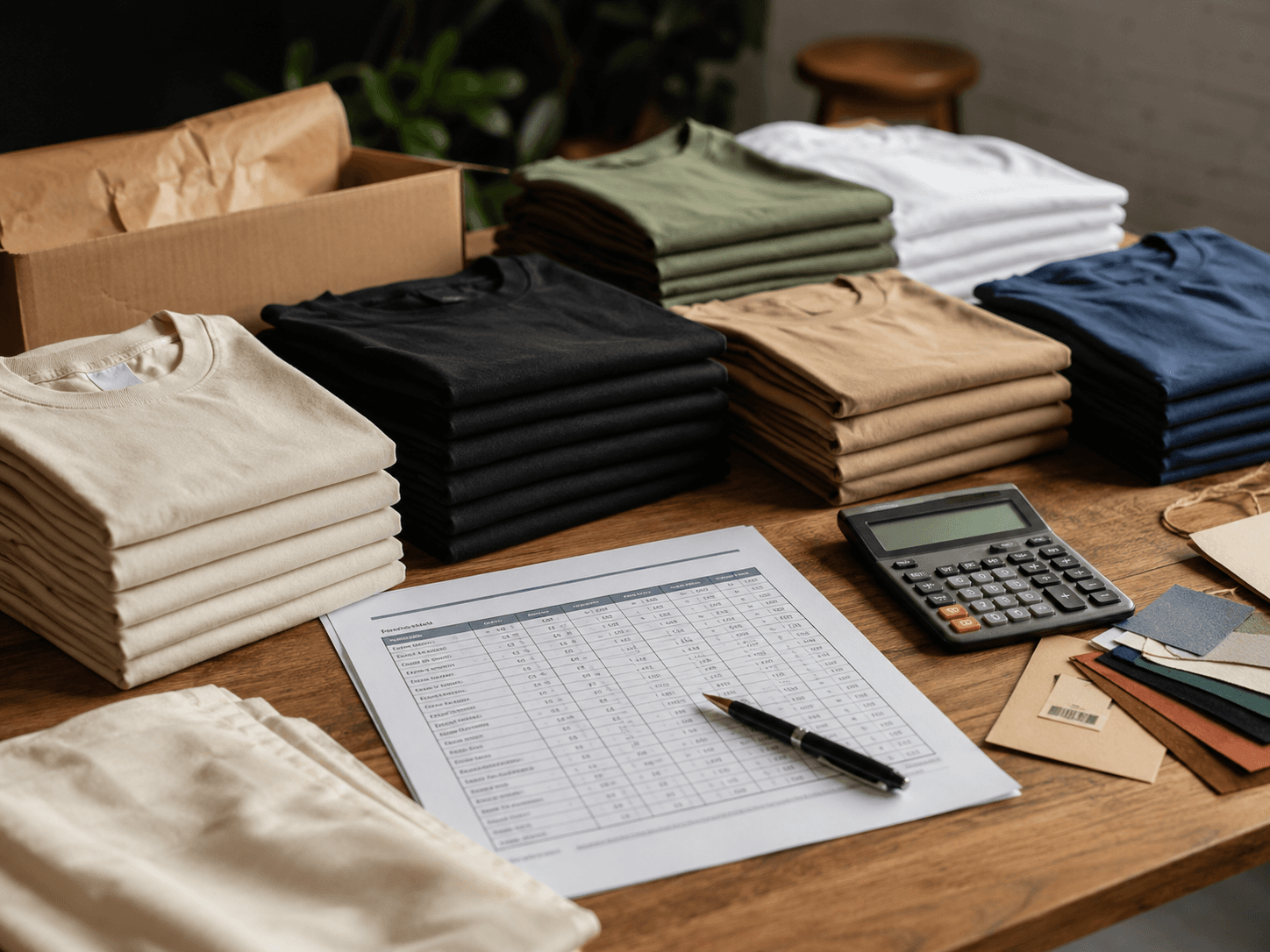
Start with your real headcount, the number of people who will actually get a shirt. Add a buffer of 5–10% for the things that always happen: no-shows who show up late, people who need a different size, new hires next month, and the odd replacement. Then round up to the nearest price break, 50, 100, or 250, because the per-piece cost steps down at each one. That's the whole method. Plug your headcount in below and it'll do the arithmetic.
Enter your headcount and we'll suggest a quantity, the pricing tier it lands in, and a size split to start from.
Why order more than your exact headcount?
Ordering your exact headcount feels precise, but it almost always backfires. A small buffer covers the predictable gaps: a handful of no-shows who still want their shirt later, people whose size runs larger or smaller than you guessed, new team members who join before the next order, and a few kept back as replacements for damaged or lost pieces. Five to ten percent is usually enough: lighter for a fixed, known group, heavier for an open event or a fast-growing team. It's the cheapest insurance you'll buy, because a reorder for five shirts pays setup all over again and costs far more per piece than adding a few to the original run.
Ordering for a 40-person company: a worked example
Say you're outfitting a 40-person company. Add an 8% buffer and you land at about 44 shirts. But 44 sits just under the 50-piece tier, the point where bulk pricing begins, so ordering 50 is the smart move. You pay only a little more in total than you would for 44 at a small-batch rate, you drop onto the better per-piece price, and you bank six spares for new hires and swaps. For most teams under about 46 people, rounding up to 50 is simply the best value. It's exactly why we work with a 50-piece price tier: below it, one-time setup dominates the math.
Ordering for a 120-person event: should you jump to 250?
Now a 120-person event. An 8% buffer puts you around 130 shirts, which lands in the 100+ pricing tier. The tempting question is whether to jump to the 250 tier for a lower per-piece price. Be honest with the math: going to 250 means buying about 120 extra shirts, so it only pays off if the per-piece savings across all 250 actually beat the cost of 120 pieces you may never hand out. For a one-off event, that's rarely worth it, order close to your buffered 130. But if this is an ongoing program with reorders, new hires, and future events, sizing up to 250 can genuinely pay for itself, because those “extras” become next quarter's inventory instead of leftovers. Decide on whether you'll actually use them, not on the per-piece number alone. For large runs, our bulk custom t-shirts page covers volume pricing and lead times.
What size breakdown should you order?
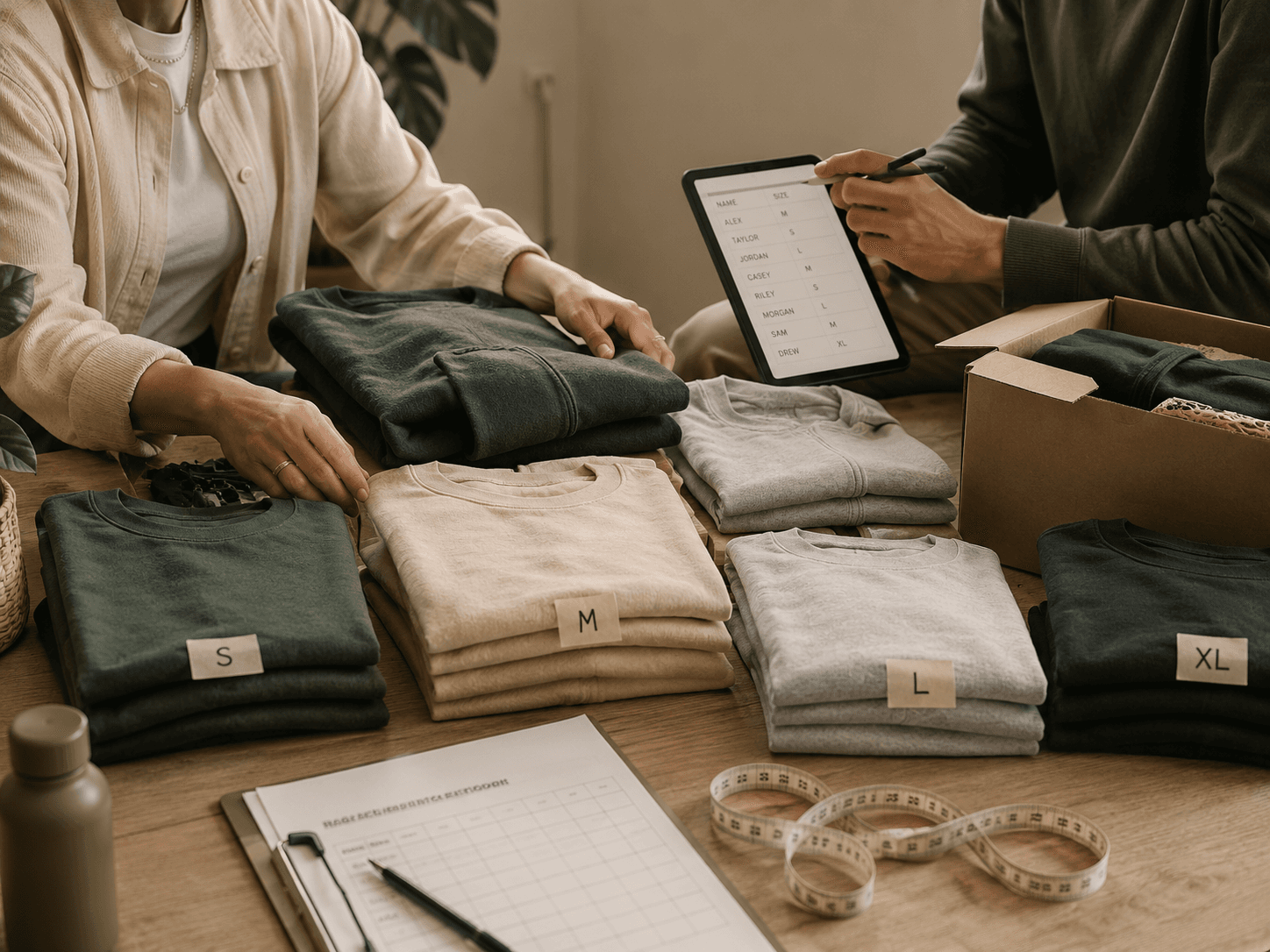
Once you know the quantity, split it across sizes. The gold standard is to collect real sizes from everyone: a quick form beats any guess, and our guide to collecting team apparel sizes walks through how. When you can't, a typical distribution for a mixed adult group is a sensible starting point: weighted toward M and L, tapering at the ends.
| Size | Typical share of the run |
|---|---|
| XS | 5% |
| S | 12% |
| M | 25% |
| L | 28% |
| XL | 20% |
| 2XL | 10% |
Adjust for your crowd: a warehouse team skews larger, a student group smaller. Extended sizes (3XL and up) cost the same per piece as everything else. Youth sizes can go on the same order and are priced on your quote.
How does quantity change the price?
Quantity is the single biggest lever on per-piece cost. Decoration has a one-time setup, screens or a stitch file, that spreads across the whole run, so it shrinks fast per unit as the count climbs, and blank pricing steps down at volume too. That's why the same shirt costs noticeably less each at 250 than at 50. To see the actual ranges by product and quantity, the custom merch cost guide lays them out, and product guides like custom hoodie pricing and custom polo pricing go tier by tier.
Ordering a smaller run?
Our pricing starts at the 50-piece tier. That's where volume pricing makes the per-shirt cost sensible, and it's what most teams and events order once a buffer is added. If your group is genuinely smaller, we'll still help: runs under 50 are quoted at small-batch rates (a little higher per piece), so tell us your number and we'll price it honestly. Questions on minimums or timelines? Call (737) 253-8727.
How many shirts to order, FAQ
Add a 5–10% buffer over your headcount for no-shows, size swaps, new hires, and replacements, then round up to the nearest price break (50, 100, or 250). Ordering exactly your headcount almost always leaves someone without a shirt.
For small groups, rounding up to 50 is usually the better value: that's where bulk pricing kicks in, so 50 often costs little more in total than a 35-piece small-batch run priced at a higher rate. Above 50, order close to your buffered headcount.
For a mixed adult group, M and L are the biggest buckets, with fewer XS and 2XL. A common split runs roughly 25% M and 28% L, tapering to 5% XS and 10% 2XL, but collect real sizes whenever you can; they always beat a curve.
Only if the per-piece savings across the bigger run beat the cost of the leftovers. For a one-off event, order close to your buffered headcount. For an ongoing program with reorders and new hires, sizing up to the next tier often pays for itself.