Apparel · 6 min read
DTF vs screen printing: which is right for your order
Two of the most popular custom t-shirt printing methods each have a clear sweet spot. Here's how DTF and screen printing compare on cost, color, detail, durability, and quantity, and how to pick the right one for your design and order size.
Quick answer
Choose DTF (direct-to-film) for small runs and detailed, full-color, or photographic designs: there's no per-color setup, so it's economical at low quantities. Choose screen printing for larger runs of bold, few-color graphics, where its low per-piece cost wins at volume. The crossover is usually around 50 pieces.
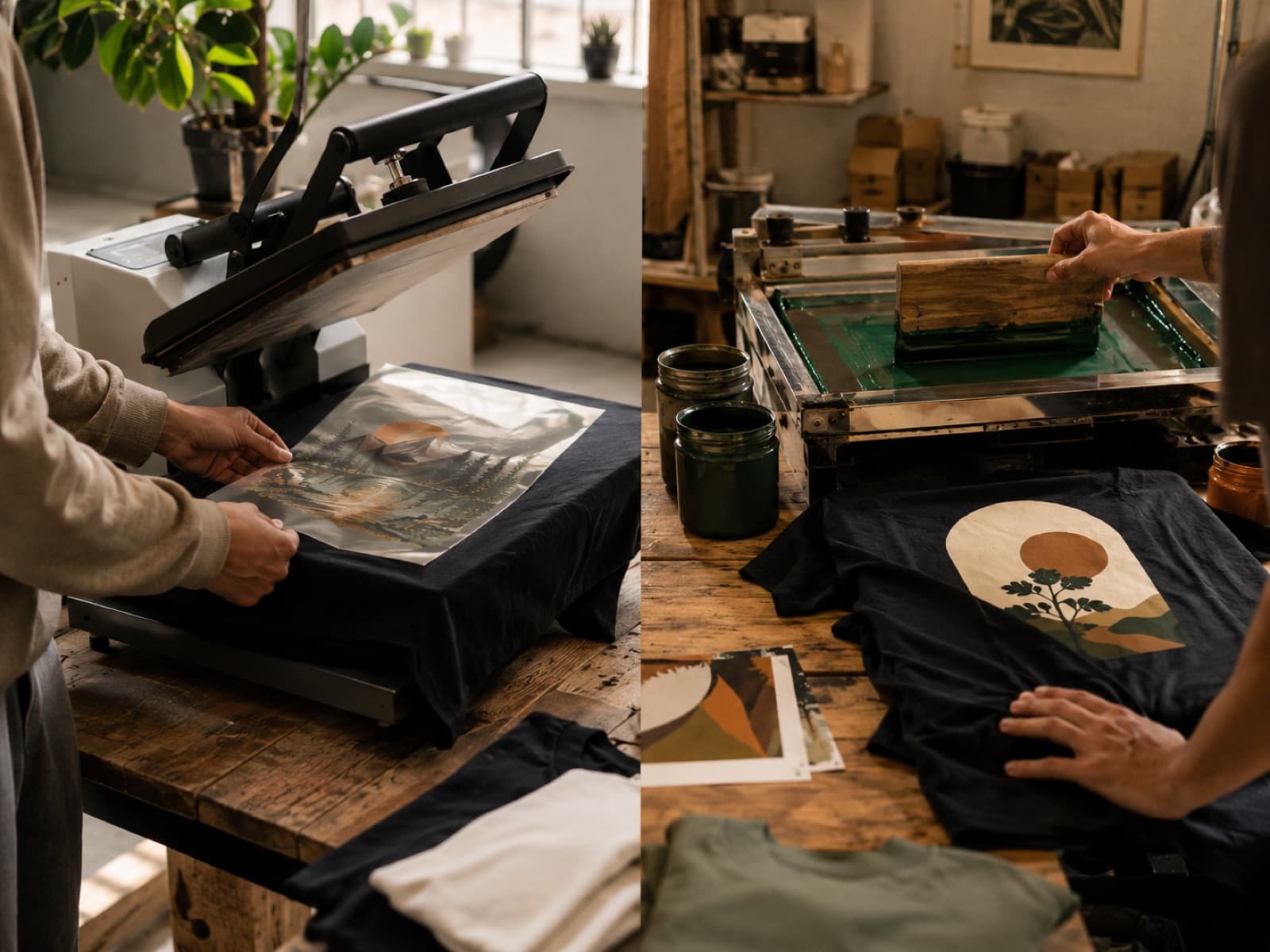
Once your artwork is ready, the next decision is how it gets applied to the garment. For most custom apparel it comes down to two methods: screen printing, where ink is pressed through a stencil onto the fabric, and DTF, where a full-color design is printed onto film and heat-pressed on. Neither is universally “better”, they suit different designs, quantities, and budgets. Get the match right and your order looks intentional instead of generic.
DTF vs screen printing at a glance
| Factor | Screen printing | DTF (direct-to-film) |
|---|---|---|
| Setup | One-time setup per color | None: a one-color logo and a full-color photo cost the same to apply |
| Cost at volume | Very low per piece; keeps dropping as quantity climbs | No color setup, so per-piece cost stays relatively flat |
| Color & detail | Flat, vivid spot color; every color adds a screen and a setup charge | Gradients, fine detail, photos, and unlimited colors with no extra cost |
| Feel | Ink pressed into the fabric: softest hand on big solid graphics | A thin, flexible layer on top: soft and stretchy, but you can feel the print |
| Fabrics | Best on cotton and standard garments | Works across cotton, polyester, blends, and tricky garments |
| Quantity crossover | Pulls ahead on price above ~50 pieces | Usually cheaper and faster below ~50 pieces |
| Best for | Large quantities and bold one- or two-color graphics | Small runs, full-color or photographic designs, and mixed garment fabrics |
What is DTF printing?
DTF stands for direct-to-film. Your full-color design is printed onto a special film, coated with an adhesive powder, and then heat-pressed onto the garment. Because the whole image is printed at once, there is no per-color setup, a one-color logo and a full-color photo cost the same to apply. That makes DTF a flexible process that works across cotton, polyester, blends, and tricky garments where screen printing struggles, with vivid color straight off the film.
Cost: screen print wins at volume, DTF wins for small runs
Screen printing has a one-time setup per color but a very low cost per piece, so it gets cheaper the more you print, the clear value choice for large runs and bold one- or two-color graphics. DTF has no color setup, so it is the more economical call for small orders, samples, and full-color art where screen printing would need many screens. The trade is that DTF's per-piece cost stays relatively flat, while screen print keeps dropping as the quantity climbs. See how both methods affect a quote in our custom merch pricing guide.
Color & detail: DTF handles full-color and photos
This is where DTF shines. Because it prints a digital image, it handles gradients, fine detail, photographic artwork, and unlimited colors with no extra cost or setup, perfect for complex designs on a custom t-shirt. Screen print lays down flat, vivid spot color that's perfect for bold logos and big designs, but every color adds a screen and a setup charge, so it's less suited to photo-real or many-color art. As a rule: if your design is full-color, gradient-heavy, or photographic, lean toward DTF; if it's a clean one- or two-color graphic at volume, lean toward screen print.
Durability & feel
Both methods are durable when done well, holding up through years of washing. The difference is in the feel. DTF sits on top of the fabric as a thin, flexible layer: soft and stretchy, but you can feel the print. Screen printing pushes ink into the fabric, so a well-done print can feel like part of the garment, especially with lighter ink coverage. For very large solid graphics, screen print often has the softest hand; for small, detailed, full-color art, DTF's thin layer is barely noticeable.
Quantity: where the crossover is
A useful rule of thumb is around 50 pieces. Below that, DTF's lack of setup usually makes it cheaper and faster: ideal for small batches, one-offs, and tests. Above that, screen printing's low per-piece cost typically takes the lead and the savings grow with the order. The exact crossover shifts with how many colors your design uses: the more colors, the more screen-printing setup adds up, and the further DTF stays ahead.
Where DTF fits among our methods
We decorate with four methods: screen printing, embroidery, DTF, and UV printing for hard goods like drinkware. DTF is our full-color option for fabric, and it has largely replaced older vinyl and inkjet transfers because the print is more durable and more vivid. If you're also weighing stitched decoration, our screen printing vs embroidery guide covers when to use thread instead of ink.
A quick way to decide
- Choose DTF for small runs, full-color or photographic designs, and orders with many colors or mixed garment fabrics: no setup, vivid detail.
- Choose screen print for large quantities and bold one- or two-color graphics, the best value at volume with the softest hand on big solid prints.
- Watch the ~50-piece line, below it DTF usually wins on price, above it screen print pulls ahead.
- Still unsure? Send the artwork and the quantity and we'll tell you which method gives the best result for the price.
The good news: you don't have to decide alone. Lay out your design in the Design Studio to preview it, or send us your artwork and we'll recommend DTF or screen print based on your design, quantity, and budget, and show you exactly how it'll look before anything is made. Questions on minimums or timelines? Our FAQ covers the details, or call us at (737) 253-8727.